Newly Published National Planning Policy Framework August 2026 – Key changes
17 August 2026
The Government has today (17 August 2026) published a new version of the National Planning Policy Framework (NPPF). It follows the draft NPPF published for consultation on 16th December 2025 and replaces the previous NPPF published in 2024.
This article provides a summary of the main changes and looks at the implications of these reforms upon developers, landowners and investors.
A new structure to national planning policy
The NPPF separates plan-making policies from national decision-making policies; the latter are material considerations from 17 August 2026.
Planning polices replace the former paragraph numbers. There are dedicated plan-making policies and national decision-making policies, with thematic codes for subjects such as housing, transport and Green Belt.
Weight to be afforded to Local Plan Policies.
Whilst the development plan remains the statutory starting point for decisions, Annex A confirms that an existing development plan policy, or part of a policy, which is materially inconsistent with a national decision-making policy should be given very limited weight.
This change reflects a pro-growth direction with a stronger support for housing, rural business, infrastructure and clean energy.
Local Plan Preparation
Authorities should design an approach to preparing and adopting local plans within 30 months of publishing a Gateway 1 self-assessment. National decision making policies should not be duplicated in local plans.
Strategic planning for growth
Spatial development strategies should plan for at least 25 years and coordinate homes, jobs, infrastructure, Green Belt and environmental priorities.
Green Belt and grey belt
Grey belt policy remains within the final version of the NPPF. Certain station-related development is not inappropriate development in the Green Belt subject to the Golden Rules.
Increased density of housing around stations.
At least 35 dph around well-connected stations, rising to at least 45 dph where service frequency is at least twice the qualifying minimum; the station definition extends to the top 80 Travel To Work Areas by GVA. A well-connected station must be in one of the top 80 Travel to Work Areas located partly or wholly in England and normally be served throughout the daytime by at least four trains or trams per hour overall, or at least two per hour in any one direction. A station can also qualify where there is a reasonable prospect of reaching that service level because of a planned upgrade or agreement with the operator.
This could create significant opportunities for sensitively designed, sustainable development
Major applications
Policy DM1 introduces a useful new national expectation for major development. Proposals should be informed by proportionate early engagement and should be accompanied by a concise planning statement.
That statement should explain how the proposal is consistent with the relevant development plan and national decision-making policies, the outcome of pre-application engagement and how the scheme changed in response, and the proposed use of planning obligations to make the development acceptable.
For other development, the new NPPF emphasises the minimum information genuinely necessary to make a decision. This links directly with the new DM2 approach to validation.
Medium development category
The NPPF now identifies medium development as housing development of 10 to 49 dwellings inclusive on a site not exceeding 2.5 hectares.
This is important for SME builders because the NPPF can apply specific policies to this middle tier while the general policies applying to major housing development continue to operate. This additional ‘tier’ should make the 10-to-49-home market more visible in national policy rather than treating everything from ten homes upwards as one undifferentiated category.
Location of new development
Policy S3 requires all planning decisions to apply a presumption in favour of sustainable development, applying a set of different policy criteria, dependant on their location. As a result, there is a default yes to development within settlements, unless the benefit of granting permission would be substantially outweighed by adverse impacts.
Outside settlements, policy S5 gives a list of certain types of development that may be allowed in the countryside. This list includes the following:
- Agriculture, horticulture, forestry, outdoor sport and recreation.
- Development for rural businesses and tourism.
- The reuse, extension, alteration or replacement of buildings.
- Development of previously developed land.
- Limited infilling.
- Development that would address unmet need from within the settlement
- Residential and mixed-use development located “within reasonable walking distance of a well-connected station” and that would be physically well-related to the settlement or station.
Economic Development
Substantial weight is given to commercial development that supports investment, expansion, adaptation and strategic economic priorities. This represents even stronger support for commercial growth than the previous NPPF.
Protection of community facilities and public houses
The new NPPF strengthens policy around the loss of public houses and other valued community facilities.
Where loss is justified on the basis that the existing use is no longer viable, the policy expects evidence that reasonable steps have been taken to market the property for its existing use without success for at least 12 months. Other routes remain where suitable replacement provision is made or adequate equivalent provision is available.
The implications are that evidence is key in demonstrating that a community facility or pub is no longer viable.
Farm businesses
Revised rural policies give stronger support to development that maintains and enhances agricultural viability and sustainability and supports domestic food production. On-farm reservoirs are recognised, alongside improved livestock accommodation, greenhouses, polytunnels, farm shops and temporary accommodation for seasonal workers where the policy conditions are met. Farm diversification and viability is supported under policy E4.
Given the above, it appears that support is now potentially stronger for agricultural diversification, where a planning application is required.
Affordable housing
Development plans should ensure no less than 40% of homes on major developments meet M4(2) accessible and adaptable standards, subject to appropriate exemptions.
Protected Landscapes
Development proposals within Protected Landscapes should be limited in scale and extent and sensitively located and designed to avoid harm to the statutory purposes and special qualities of the Protected Landscape. Substantial weight should be placed on the importance of conserving and enhancing the natural beauty. Major development within Protected Landscapes should be refused other than in exceptional circumstances and where it is in the public interest.
Clearly strong environmental constraints remain and continue to be an issue which needs to be addressed in any proposal.
Flood Risk Assessment (FRA)
Enhanced guidance on FRA and Sustainable Drainage Systems (SuDS).
Opinion
The new NPPF represents a significant update and a clear move in the pro-growth direction. There is stronger support for housing, rural business, infrastructure and clean energy, but the wording of the new policies will still require careful analysis. It is evident however that for landowners, developers and rural businesses, there are potentially increased opportunities.
Please contact one of our expert planning team to discuss how the changes could affect your development potential:
Claudia Jones (Associate Planner) – 07760 351647
Grant Baylis (Associate Planner) – 07795 247951
Other News
Retrospective planning permission has been secured for over 2,250 m2 of equestrian buildings, including ancillary accommodation, at Kilsby Grange, Northamptonshire. MEP were instructed by a private client to regularise the position on site following an enforcement enquiry by West Northamptonshire Council. The site comprises an established residential property in the open countryside with associated equestrian […]
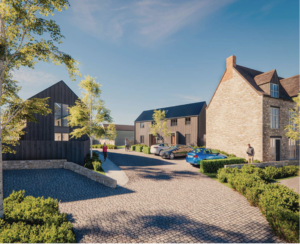
On behalf of Renishaw PLC, the MEP team is delighted to have secured permission for the conversion of two existing buildings to 5 dwellings alongside the erection of 4 new dwellings in the town centre of Wotton-Under-Edge. The existing buildings, which were formerly a schoolhouse and an office building, comprise one Grade II listed building […]
The Government has today (17 August 2026) published a new version of the National Planning Policy Framework (NPPF). It follows the draft NPPF published for consultation on 16th December 2025 and replaces the previous NPPF published in 2024. This article provides a summary of the main changes and looks at the implications of these reforms upon developers, […]